
Let me guess.
You spent a Sunday afternoon with a tiny Allen wrench. You followed a YouTube tutorial that skipped three steps. And now your new desk wobbles every time you type the letter T.
You tell yourself it’s fine. It was cheap. You’ll fix it later.
But later never comes. And three years from now, that desk will be in a landfill. Or worse—still in your apartment, slowly sagging, making you slightly annoyed every single day.
We are living in the era of fast furniture. It’s the home decor equivalent of fast fashion. It looks great in the unboxing video. It photographs beautifully for Instagram. But it’s designed to be disposable.
Here is the hard truth about five popular furniture categories—and what you should buy instead if you want pieces that last, hold their value, and don’t make you want to throw them out a window.
1. The £200 Amazon Desk: The Particle Board Trap
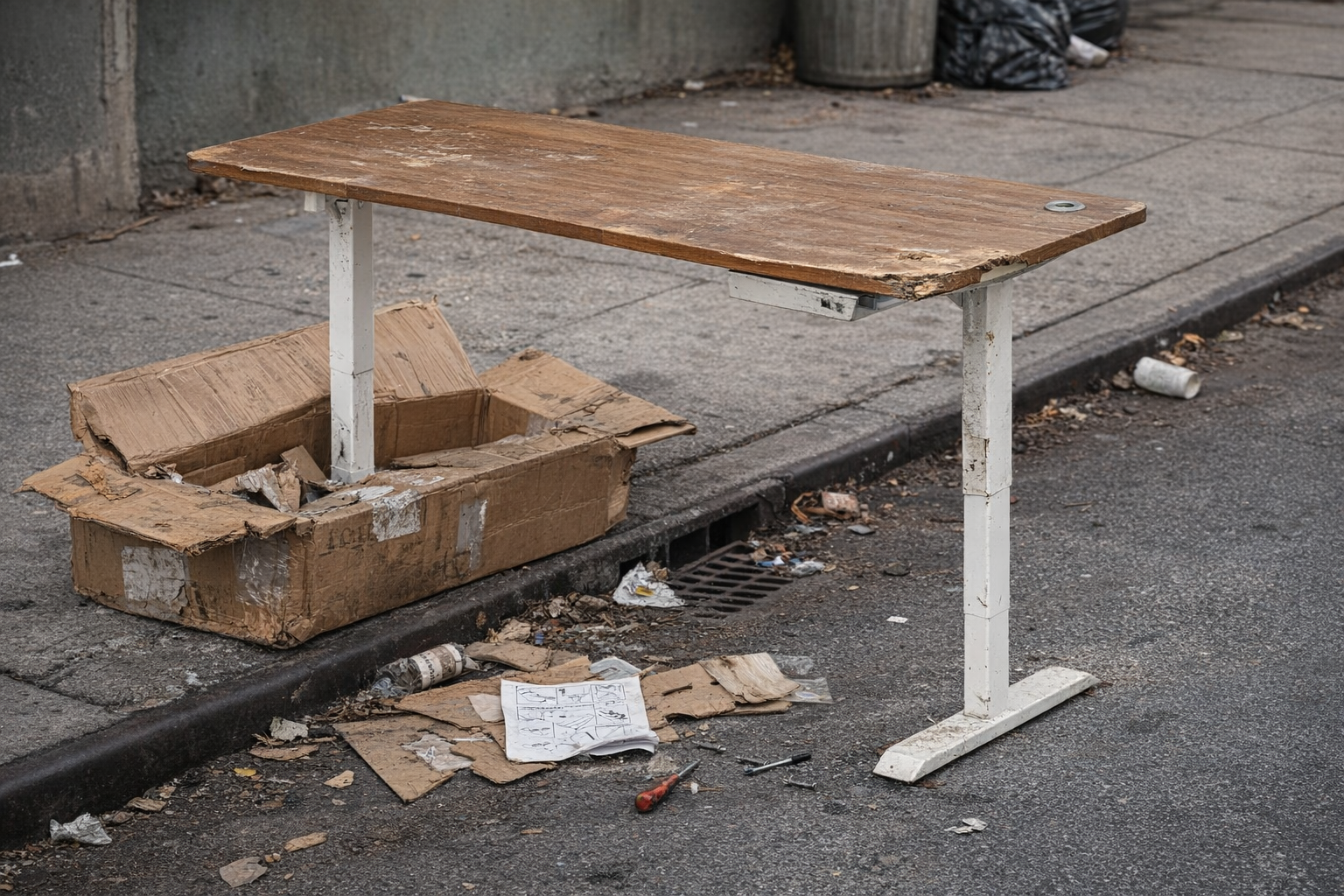

The Regret
You found it. The “executive style writing desk.” Only $179. Free shipping. 4.5 stars.
What arrives is a 40-pound box of compressed sawdust wrapped in a thin layer of wood-print vinyl. The instructions are blurry diagrams of arrows going into circles. Three screws strip immediately. One leg sits slightly off the floor.
Within six months, the drawer sags. Within a year, the laminate peels at the edges. When you move apartments, it’s heavier than solid wood but somehow more fragile. You leave it on the curb.
The Fix: Vintage Teacher Desks
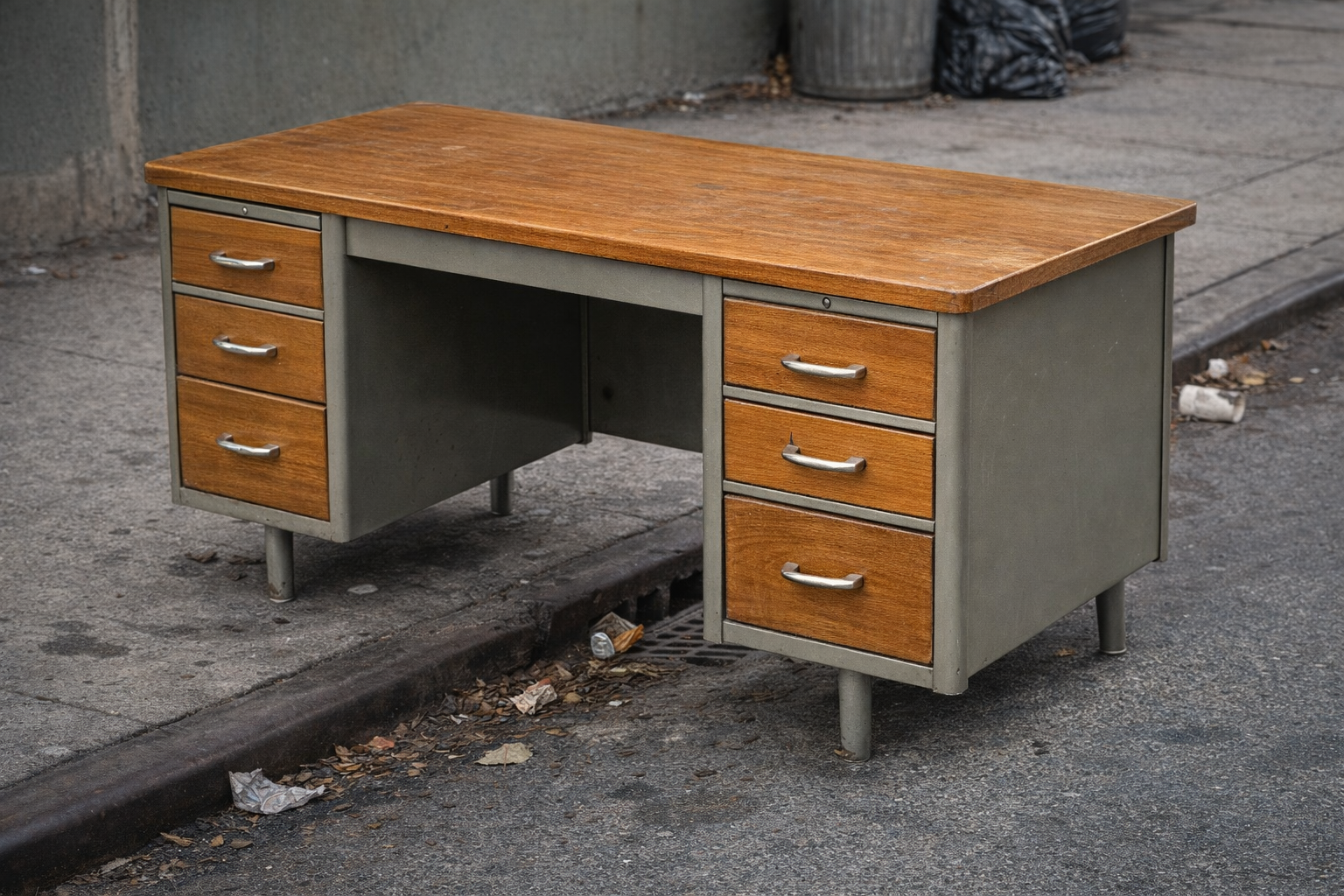

Walk into any Facebook Marketplace or estate sale and look for steel-frame desks from the 1950s–1970s. They were built for teachers throwing chalk and principals filing reports. Solid wood tops. Actual dovetail drawers. Hardware that feels substantial in your hand.
Yes, they might have scratches. Yes, the finish might be dated. That’s the point.
Sand it down or paint it. Swap the knobs. You’ll spend the same amount as the Amazon desk, but this one will outlive your grandchildren.
The Shareable Takeaway: If it requires a hex key to assemble, it requires a landfill to dispose of.
2. The Boucle Chair: The Stain Magnet
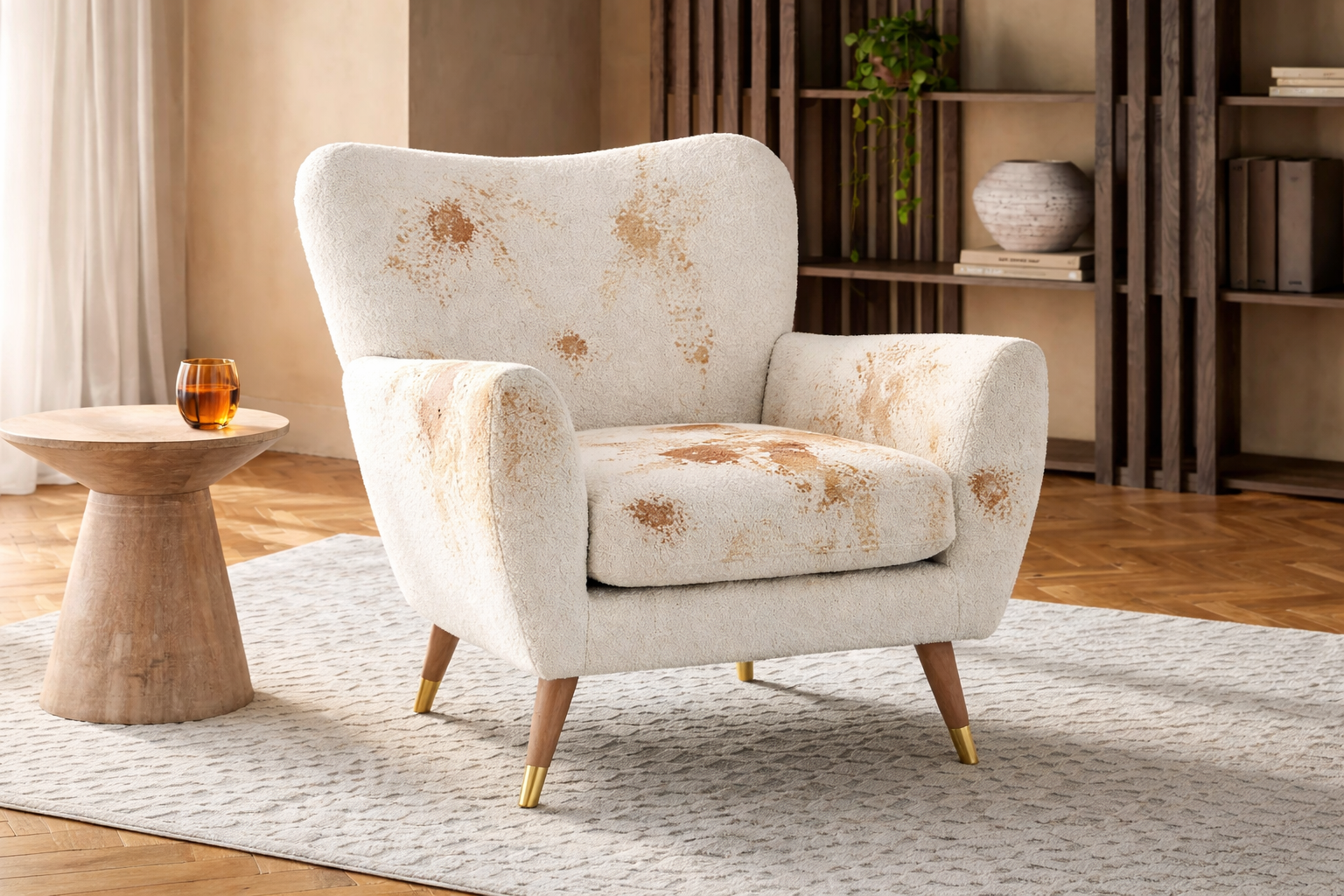

The Regret
You saw it everywhere. Curvy. Creamy. Textured. The boucle armchair looked like a cloud in every designer’s living room.
So you bought one.
Then you wore jeans on it. Then someone set down a coffee cup. Then your cat looked at it.
Boucle is the suede of the 2020s. It shows every fingerprint, every water droplet, every single moment of human existence. Professional cleaning costs half what you paid for the chair. Most stain treatments just push the dirt deeper into the loops.
The Fix: Performance Velvet or Vintage Leather
Performance velvet is machine-washable fabric disguised as luxury. It repels liquids, resists crushing, and actually improves with use as the fibers soften.
Vintage leather is the other answer. A worn-in leather chair from the 1970s doesn’t hide stains—it accumulates patina. Scratches become character. Fading becomes depth. It arrives pre-forgiven for all the accidents it hasn’t experienced yet.
The Shareable Takeaway: If you have pets, children, or red wine, boucle is the enemy.
3. The Matching Bedroom Set: The Style Killer
The Regret
You bought the set. Bed frame, two nightstands, dresser, mirror. All the same finish. All the same hardware. All delivered together in one triumphant shipment.
Now your bedroom looks like a hotel. Or a furniture showroom. Or a catalog page where nobody actually lives.
The problem isn’t the quality—it’s the rigidity. That matching set dictates everything else in the room. Your wall color must complement it. Your bedding must coordinate with it. You can’t swap out one nightstand without the whole thing falling apart visually.
The Fix: Mix-and-Match Eclecticism
Pick one anchor piece—usually the bed frame—and let everything else breathe.
Nightstands don’t have to match each other, let alone the bed. A wooden carved side table on one side, a minimalist metal frame on the other. Different heights. Different finishes. Different decades.
The goal isn’t perfection. It’s the collected-over-time look that says “a person lives here” rather than “a stylist left an hour ago.”
The Shareable Takeaway: Stop buying sets. Your bedroom isn’t a hotel.
4. The Cheap Sectional: The Sinkhole
The Regret
You measured your living room. You measured the doorway. You measured again. The sectional fit. Barely.
But here’s what they don’t tell you in the reviews: the back is too low, the seat is too shallow, and the cushions flatten within eight weeks of Netflix.
To make it comfortable, you buy four throw pillows for lumbar support. Then a blanket to hide the sagging. Then you realize you’re spending more on accessories than you saved on the couch.
The Fix: The Golden Ratio Rule
Before buying any sofa, measure the seat depth. You want 24 inches or more.
That extra three inches is the difference between perching and lounging. Between needing pillows and sinking into proper support.
Also: look for eight-way hand-tied springs if you’re investing, or simply buy vintage. Sofas from the 1960s were built with hardwood frames and springs that still bounce today. Reupholstery costs money, but you’re paying once instead of every three years.
The Shareable Takeaway: You shouldn’t need three throw pillows to make a couch comfortable.
5. The Disposable Shelf: The Dust Collector
The Regret
Particle board shelving. Wire cubes. Lattice-style “decorative” units with a hundred tiny compartments.
These aren’t shelves. They’re dust farms.
Every horizontal surface collects dust, sure. But those little wire racks and open cubbies require specialized cleaning motions. You can’t just swipe a cloth. You have to navigate the gaps, the corners, the weird overhangs.
Within months, these shelves become storage for things you don’t care about—cables you’ll never use, papers you should recycle, objects you keep only because they fit in that one specific cube.
The Fix: Solid Wood Floating Shelves or Vintage Ladders
A solid wood floating shelf—properly anchored into studs—holds books, art, plants, weight. It’s a single surface. You clean it in one pass.
Or consider a vintage library ladder or industrial pipe shelving. These pieces have airflow without fragmentation. They display your belongings rather than trapping them.
The Shareable Takeaway: Buy it for life, or buy it twice.
The Deeper Problem
Here’s what fast furniture really costs:
Your time. Hours of assembly. Hours of troubleshooting. Hours of searching for replacement parts that don’t exist.
Your space. Wobbly desks and sagging sofas stay in our homes long after we stop liking them, because replacing them feels wasteful.
The planet. The EPA estimates furniture accounts for over 9 million tons of landfill waste annually. Most of it is particle board, polyurethane foam, and bonded leather—materials that don’t degrade and can’t be recycled.
Your self-respect. There’s a quiet dignity in owning things built to last. In opening a drawer that glides smoothly. In sitting on a sofa that supports your back. In walking past a desk that doesn’t wobble.
That dignity isn’t about money. Vintage solid wood desks cost the same as new particle board ones. Mid-century sofas need reupholstery, but you’d replace a cheap couch twice in the same timeframe.
The difference isn’t budget. It’s patience. It’s knowing what to look for. It’s refusing to settle for furniture designed to fail.
The One-Question Test
Before you buy anything else, ask yourself:
Would I want to move this to my next apartment?
If the answer is no, don’t buy it now. You’re just renting space for someone else’s future landfill.
Wait. Save. Hunt. Find the piece that makes you think, “I’m taking this with me when I go.”
That’s the one worth having.
What piece of furniture in your home do you regret the most? Drop it in the comments. I’ll tell you if it’s worth keeping or if you should finally leave it on the curb.
