
For decades, the conversation around office design was largely aesthetic. Did the space look impressive to clients? Did it reflect the brand’s colors? While visual appeal remains important, modern business psychology has shifted the focus toward a much more critical metric: employee performance. The link between where we work and how we work is undeniable. The right office setup is no longer just a perk; it is a strategic tool for enhancing productivity, fostering collaboration, and reducing turnover.
In an era where talent retention is fiercely competitive, companies are realizing that the physical environment is a silent partner in their success. A poorly lit, cramped, or noisy office can drain energy and morale, while a thoughtfully designed space can energize staff and streamline workflow. But what does the “right” setup actually look like? It moves beyond the generic, one-size-fits-all cubicle farm and ventures into the realm of intentional design.
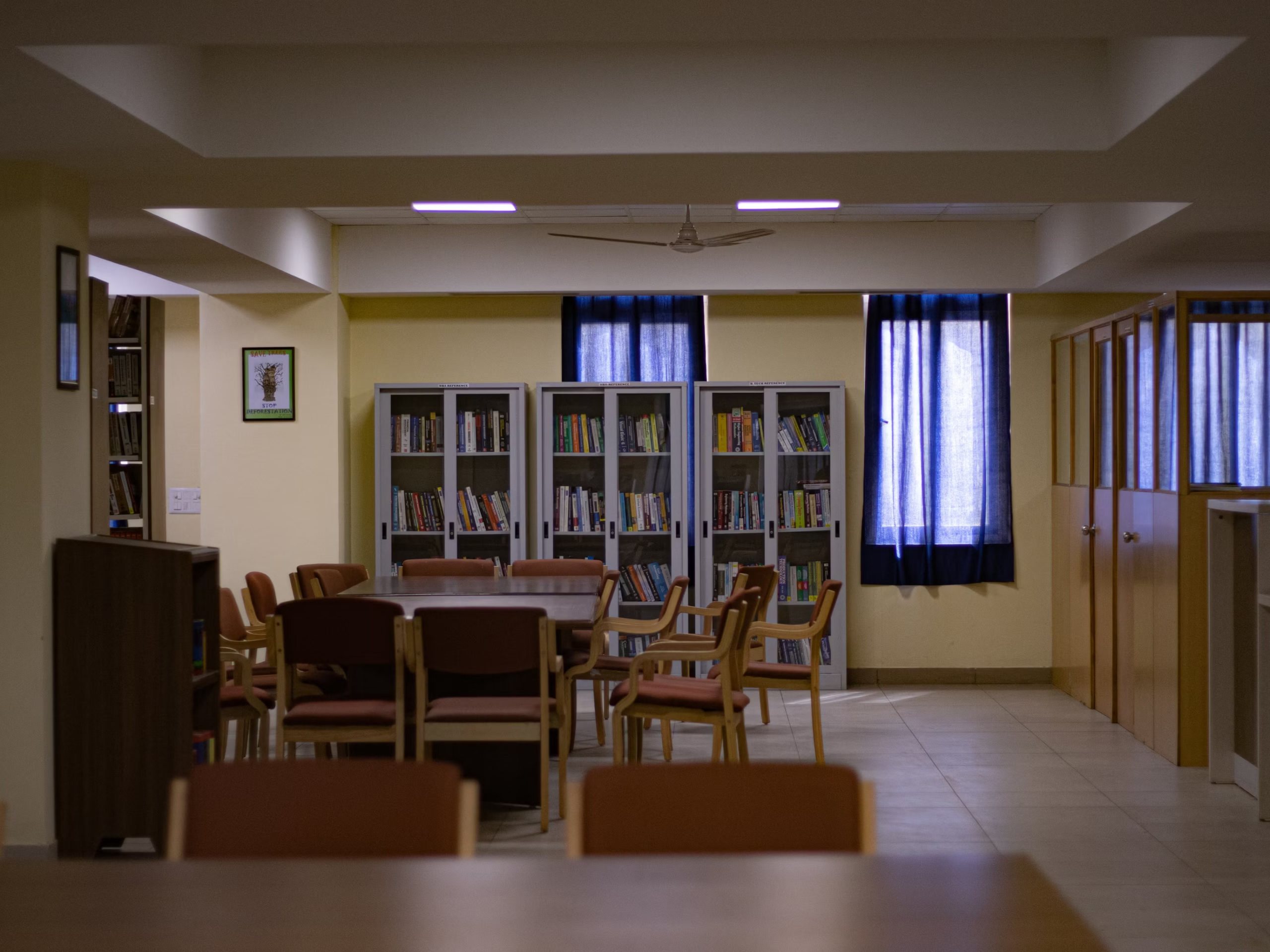
In the second paragraph of our exploration, it is crucial to address the physical interface between the employee and their work: the furniture itself. Standard desks and chairs are designed for the “average” person, but in reality, no two bodies or work styles are the same. This is where the conversation naturally turns to the value of tailored solutions. Investing in bespoke office furniture allows a company to move beyond the limitations of mass-produced items. When furniture is tailored to the specific dimensions of a space and the specific needs of the employees using it, it eliminates the physical friction that hinders performance. An adjustable desk that fits a unique alcove perfectly or a chair designed with the specific support a team needs can drastically reduce physical fatigue, allowing the mind to focus solely on the task at hand.
The Psychology of Space and Focus
The impact of the office setup on performance is deeply rooted in environmental psychology. Our surroundings constantly send signals to our brain, influencing our mood and cognitive function. High ceilings might promote abstract thinking, while lower, cozier spaces can foster focused, detailed work. If an office layout is chaotic, with cables running across walkways and clutter building up on surfaces, it creates a subconscious sense of disorder. This visual noise competes for our attention, leading to cognitive overload and reduced concentration.
Conversely, a clean, organized, and well-structured environment promotes a sense of control and calm. Strategic zoning is a key component of this. High-performing offices are now being designed with “activity-based working” in mind. This means creating distinct zones for different tasks: quiet zones for deep focus, collaborative hubs for team meetings, and social break areas for relaxation and informal interaction. When employees have the agency to choose where to work based on the task they are doing, their efficiency skyrockets. They aren’t trying to write a complex report in the middle of a noisy brainstorming session, nor are they trying to collaborate in a library-like silence.
Ergonomics and Health: The Foundation of Stamina
You cannot have high performance if your staff is in pain. Yet, for years, office workers have endured the “ergonomics lottery,” hoping that the standard issue chair and desk will suffice. The data proves otherwise. Musculoskeletal disorders, eye strain, and general physical discomfort are leading causes of presenteeism—where employees are at work but not fully functioning due to distraction or pain.
A strategic office setup prioritizes ergonomics as a baseline, not an upgrade. This includes monitor arms to position screens at the correct height, keyboard trays to ensure proper wrist angles, and most importantly, seating that supports the spine’s natural curvature. As we move into the fourth and fifth paragraphs of this discussion, we must consider the holistic environment. Natural light, for example, is a massive performance driver. Studies show that workers near windows sleep longer and better, and report a higher quality of life, which translates directly into better focus during work hours.
Furthermore, the quality of materials and finishes plays a role in acoustic performance. Open-plan offices, while popular for collaboration, are notoriously bad for focused work due to noise distractions. The right setup mitigates this through acoustic panels, sound-absorbing ceiling tiles, and soft furnishings. When a company decides to address these specific acoustic challenges, they often find that standard partitions don’t fit the unique workflow of their space. This is another instance where custom solutions shine. Incorporating bespoke office furniture that includes integrated acoustic baffles or custom-height privacy screens can solve noise issues without sacrificing the open-plan aesthetic, creating a “buzzing” but not “deafening” environment that keeps performance high.
Fostering Collaboration and Culture
Performance isn’t just about individual output; it’s about how well a team functions as a unit. The office layout is the physical infrastructure of your company culture. If your setup consists solely of rows of desks facing the same direction, you are signaling that individual, siloed work is the only priority. To improve performance, you need to facilitate the spontaneous interactions that lead to innovation.
Breakout spaces with comfortable, moveable furniture encourage teams to gather and whiteboard ideas. Centralized pantries or coffee points act as “collision spaces” where employees from different departments can bump into each other, fostering cross-pollination of ideas. The visual connectivity of an office also matters. Glass-walled meeting rooms, for instance, allow people to see that collaboration is happening, encouraging a more open and transparent culture. When the physical barriers come down, the communication barriers often follow.
Future-Proofing Through Flexibility
Finally, a high-performance office is one that can adapt. The needs of a business today may be completely different six months from now. The wrong setup is rigid and expensive to change; the right setup is agile. This means investing in furniture on wheels, modular storage systems, and writable surfaces that can be easily moved.
This flexibility extends to technology as well. A modern high-performance office is seamlessly integrated with power and data. “Tech hospitality”—the ease with which employees can charge devices and connect to networks—is a non-negotiable aspect of productivity. No one should have to hunt for an outlet or suffer from poor Wi-Fi in specific zones.
In conclusion, viewing the office setup as an expense rather than an investment is a critical business mistake. From the strategic zoning of space to the ergonomic support of the body, every design choice either fuels or hinders employee output. By prioritizing the physical and psychological comfort of the workforce through intentional design and tailored solutions, businesses create an environment where employees don’t just work—they thrive. The result is a more engaged, healthier, and undeniably more productive team.
