
Have you ever walked past a piece of furniture on the curb or buried in a dusty corner of a thrift store and seen not junk, but potential? In a world of mass-produced, flat-pack sameness, there’s a growing yearning for spaces that tell a story, that feel collected and personal. The secret to achieving this doesn’t lie in a luxury showroom; it’s often found in the forgotten, the worn, and the well-loved. The art of reclaiming furnitureis your ultimate tool for injecting soul, history, and undeniable charm into your home.

This isn’t about a simple coat of paint on a tired dresser (though that’s a great start!). It’s a creative philosophy—a way of seeing the beautiful bones beneath the surface and giving pieces a new chapter in your story. Let’s explore some unique ideas that go beyond the expected.
The Philosophy of “Perfectly Imperfect”
First, shift your mindset. The goal isn’t to make an old piece look brand new. It’s to honor its journey. That watermark on the oak table? That’s a patina of family meals. The chipped paint on a wicker chair? That’s evidence of sunny afternoons on a porch. Your job isn’t to erase these but to enhance them, to stabilize the piece and make it functional while letting its character sing.
Idea 1: The Fragment as Feature
One of the most striking approaches is to use only a part of a salvaged item. Don’t feel pressured to restore an entire, cumbersome piece.
-
Door Headboard: A solid, paneled wooden door—especially one with peeling paint or a glass knob—makes a majestic headboard. Simply secure it to the wall behind your bed. Its height and architectural detail instantly become a bedroom focal point.
-
Drawer Shelves: Remove a drawer from a broken chest, sand it lightly, and add picture frame hooks to the back. Hang it on the wall as a singular, deep shelf for displaying a vase, a stack of books, or a small plant. Cluster several drawers of varying sizes for an eclectic gallery wall.
-
Chair Back Trellis: The carved back of a broken wooden chair can be mounted on a patio or garden wall to serve as a charming trellis for climbing vines or sweet peas.
Idea 2: Juxtaposition is Key
The magic often happens in the contrast between old and new, rough and refined.
-
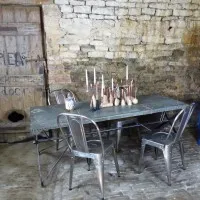
Industrial-Meets-Rustic: Pair a heavily weathered, wood-plank table with sleek, transparent acrylic chairs. The transparency of the chairs keeps the focus on the table’s texture, while the modern shape creates exciting tension.
-
Elegant Upholstery on Raw Frames: Find a vintage armchair with a solid frame but ruined fabric. Instead of a prim, traditional print, reupholster it in a bold, modern graphic or a lush, luxurious velvet. Leave the wooden frame in its raw, scratched state, or simply oil it to highlight the wear. This blend of rugged frame and plush fabric is effortlessly cool.
Idea 3: Celebrate the “Flaws”
Sometimes, the best technique is minimal intervention.
-
The Preserved Paint Peeler: A dresser with layers of paint chipping away to reveal histories of color beneath is a treasure. Clean it gently, apply a clear matte sealant or wax to stop further flaking and protect the surface, and let it be. It’s a living piece of art.
-
Highlighting Repair Marks: Instead of hiding a structural repair, accentuate it. Use contrasting butterfly keys (bowtie-shaped inlays) to stabilize a crack in a tabletop. Not only is it structurally sound, but it also becomes a celebrated design element, showcasing the piece’s survival.
Idea 4: Repurpose with Imagination
Think completely outside the (furniture’s) original box.
-
Sewing Table to Bathroom Vanity: An old treadle sewing machine base, with its iron scrollwork and pedal, provides a stunningly unique base for a bathroom vanity. A marble or live-edge wood slab placed on top creates a breathtaking centerpiece.
-
Ladder to Blanket Rack: A simple, worn wooden ladder can be cleaned, secured horizontally to a wall, and used to drape throws, quilts, and scarves. It’s functional, rustic, and a beautiful way to add texture.
-
Window Frame to Room Divider: Attach multiple old window frames (with or without glass) together with hinges. This creates a lightweight, architectural room divider that separates spaces without blocking light, perfect for studios or open-plan living areas.
Getting Started: Your Reclaiming Toolkit
You don’t need a professional workshop. Start with the essentials: a good screwdriver set, sandpaper in various grits (for smoothing, not necessarily stripping), a sturdy paintbrush, a non-toxic cleaning solution, and a quality sealant (like polyurethane or furniture wax). Your most important tools are your eyes and patience. Inspect pieces for sturdiness, solid wood construction, and interesting details. Test for lead paint if sanding very old pieces, and always work in a well-ventilated space.

Remember, this process is meant to be joyful and creative. There’s no “wrong” outcome. Each scratch you leave, each modern element you introduce, writes a new sentence in the object’s story. By choosing to give a forgotten item a new purpose, you’re not just decorating—you’re curating a home with depth, warmth, and a narrative that is uniquely yours. You’re building an environment that no catalog can replicate, one thoughtfully saved piece at a time. This conscious act of reclaiming furniture is the most authentic way to craft a space that is truly, and charmingly, your own.