
More than a mere piece of furniture, the apothecary cabinet—and its close relative, the apothecary table—has become a powerful visual archetype in our shared storytelling. In film, literature, and games, these objects instantly telegraph a rich set of ideas: arcane knowledge, hidden secrets, and the delicate boundary between science and magic. This page explores how the cabinet apothecary has been cemented in our collective imagination as a symbol of discovery, mystery, and transformation.
The Symbolic Weight of the Form
At its core, the apothecary cabinet is a metaphor made physical. Its very design evokes specific, universal themes:
-
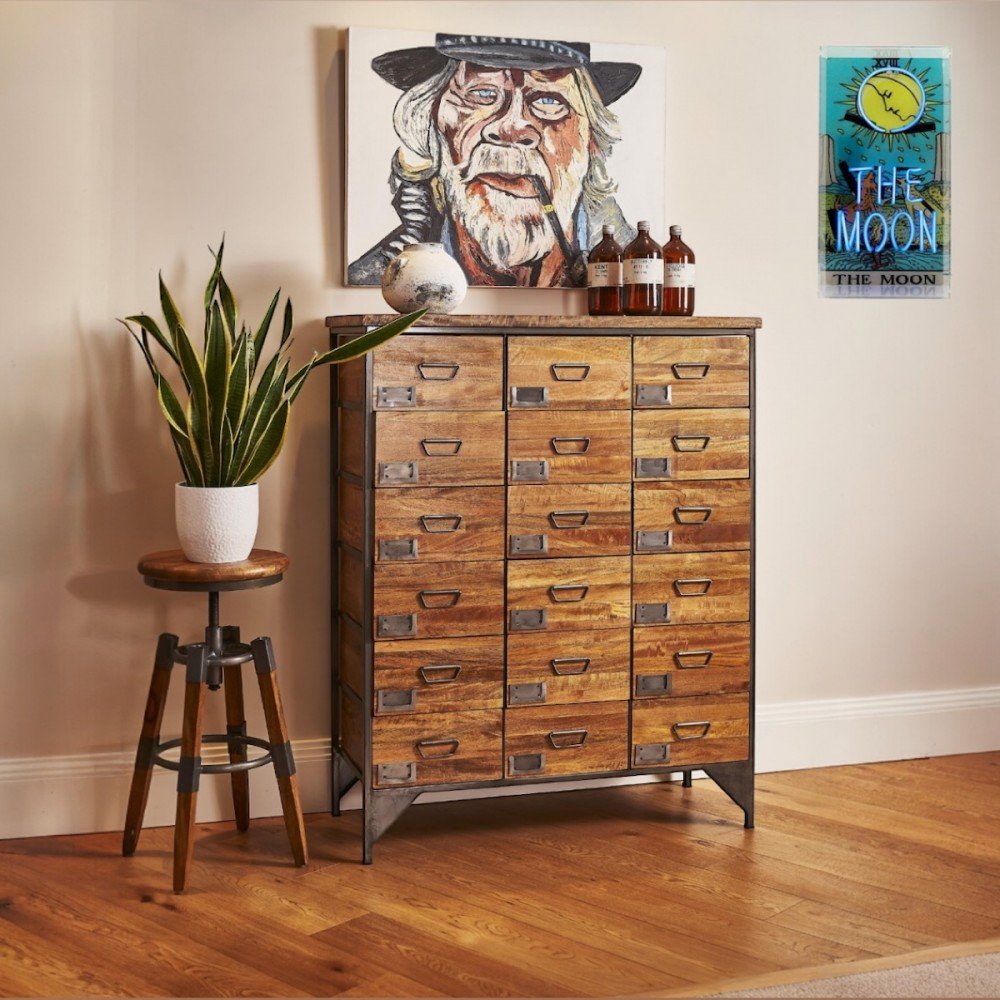
The Archive of Secret Knowledge: Its countless small drawers suggest compartmentalized, esoteric wisdom. It represents the systematization of mysteries, implying that nature’s secrets—both curative and poisonous—can be cataloged and mastered.
-
The Liminal Space: Historically, the apothecary was a bridge between the herbalist’s garden and the physician’s surgery. In culture, the apothecary table, laden with strange instruments and bubbling alembics, becomes a stage for transformation, where the mundane becomes miraculous.
-
Order Versus Chaos: The precise grid of the cabinet apothecary stands for human attempts to impose order on the natural world. It is the organized mind confronting the wild, unknown, and often dangerous forces of nature and disease.

Archetypal Settings & Appearances
The apothecary cabinet serves as a key piece of visual shorthand, quickly establishing character and setting:
-
The Gothic & Horror Laboratory:
-
Setting: The quintessential mad scientist’s lab or ancient vampire hunter’s study.
-
Function: Here, the apothecary table is a workbench for forbidden experiments. Bottles of glowing liquids and strange specimens line the shelves above a well-worn cabinet apothecary, from which the protagonist extracts a crucial ingredient (wolfsbane, rare orchid, powdered mandrake).
-
Example: Films like The Bride of Frankenstein or Dracula (1931) established this trope, which continues in shows like Penny Dreadful.
-
-
The Fantasy Alchemist’s Workshop:
-
Setting: The workshop of a wizard, potion-master, or healer in fantasy worlds.
-
Function: The cabinet apothecary holds magical components (dragon scale, phoenix feather, mermaid’s tear). Its presence grounds magical potion-making in a tactile, almost scientific process, blending the mystical with the methodological.
-
Example: The storied ingredients in the Harry Potter series, while often in jars, conceptually spring from this apothecary cabinet tradition. Video games like The Witcher 3 and Skyrim frequently feature these cabinets in alchemy shops.
-
-
The Historical Drama & Period Mystery:
-
Setting: An 18th or 19th-century doctor’s surgery, a village herbalist’s cottage, or a detective’s clue-filled room.
-
Function: It authenticates the historical setting. A detective might find a poison in an apothecary cabinet labeled “Arsenicum,” or a heroine might seek a remedy from a wise healer’s apothecary table.
-
Example: Shows like Sherlock Holmes adaptations (particularly those set in the Victorian era) or films like The Libertine use these pieces to create verisimilitude.
-
-
The “Cabinet of Curiosity” Aesthetic:
-
Setting: The home of an eccentric collector, artist, or intellectual.
-
Function: Transformed from its original use, the cabinet apothecary becomes a display case for fossils, artifacts, insects, or other wonders. It symbolizes the owner’s inquisitive mind and desire to possess and categorize the world’s marvels.
-
The Apothecary Table as a Stage for Drama
While the cabinet is for storage, the apothecary table is for action. It is the proactive counterpart:
-
It’s where potions are mixed, clues are examined under a magnifying glass, and fateful decisions are made.
-
Its surface, often stained and scarred, bears witness to history and experimentation. In a scene, the action happens at the apothecary table, while the cabinet holds the potential for that action in its drawers.
Why It Endures in Collective Memory
The enduring power of the apothecary cabinet in culture stems from its unique intersection of qualities:
-
Tangible History: It feels authentically old, connecting us to a pre-digital, hands-on world.
-
Inherent Mystery: Closed drawers inherently promise hidden contents, triggering curiosity.
-
Aesthetic Appeal: Its ordered, geometric design is visually satisfying and photographically compelling.
-
Narrative Utility: It is a versatile prop that can serve as a treasure trove, a source of danger, or a symbol of a character’s expertise.
Conclusion
From symbolizing the dark arts to authenticating a historical world, the apothecary cabinet and apothecary table are more than set dressing. They are narrative devices embedded in our collective memory. They remind us of a time when discovery was physical, when knowledge was stored in drawers rather than clouds, and when the line between healer and mystic was drawn across a well-worn wooden table. In our modern era, they persist as powerful icons of enigmatic wisdom and the enduring allure of the secret, waiting to be unlocked.