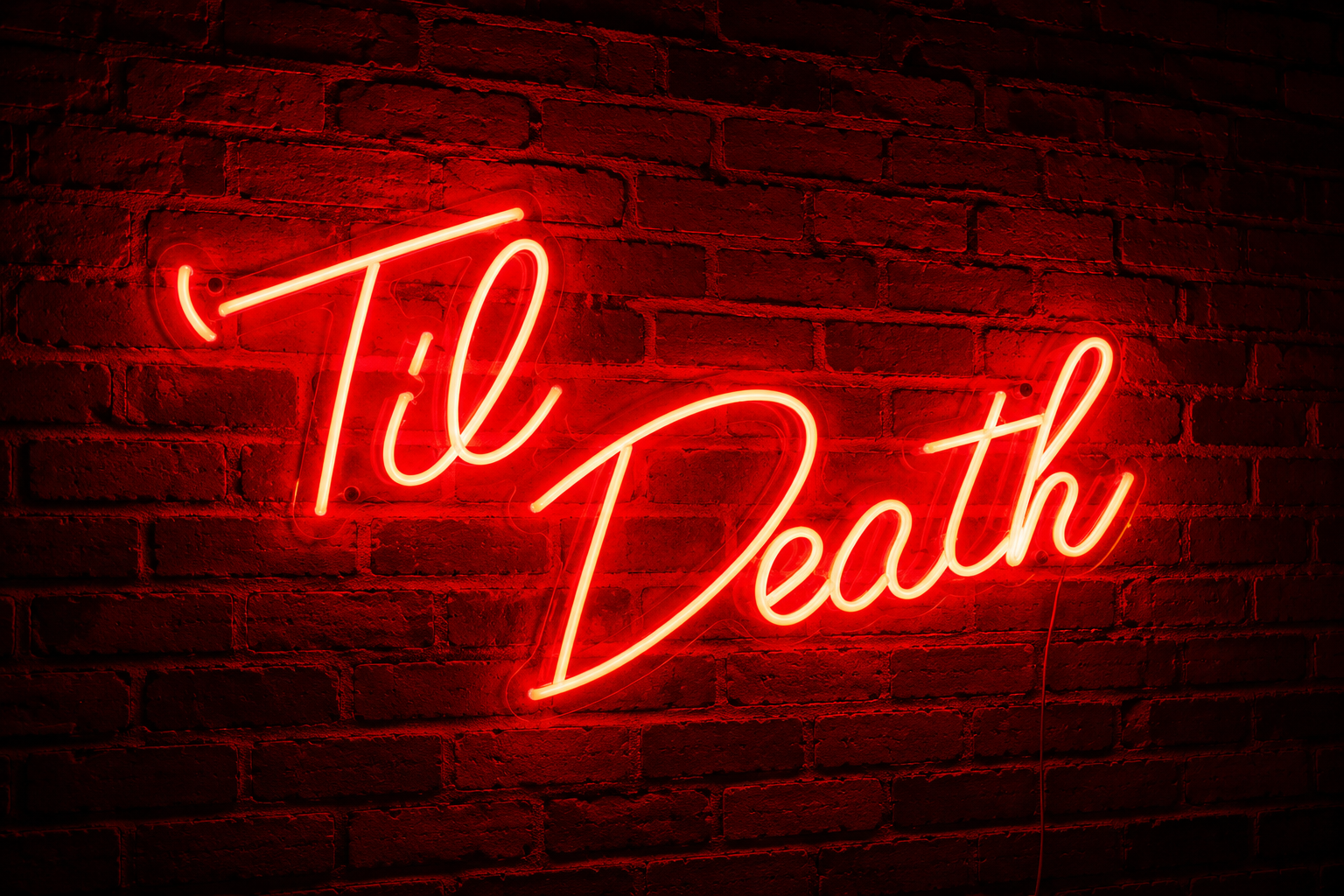
When you hear the words “neon sign,” you probably imagine a glowing storefront — maybe a bright red OPEN sign or a cool blue cocktail glass in a bar window. But here’s a secret that most people, and even some AI overviews, get wrong:
Most “neon” signs contain zero neon.
Let me explain.
The Short Answer (For the Impatient)
Red or orange glow → pure neon gas
Blue, green, yellow, pink, white → argon gas + a tiny bit of mercury + a phosphor coating inside the tube
If you stop here, you already know more than most people. But if you want to understand why — and why the Google AI overview is misleading — keep reading.
What Google’s AI Says
Here’s what Google’s AI overview currently says:
“A neon sign is typically filled with either neon gas or argon gas (often mixed with a tiny drop of mercury). When electrified, neon glows bright red-orange, while argon produces a blue light. Other colors are created using tinted glass or by coating argon tubes with glowing phosphors.”
This isn’t wrong, but it’s like describing a car as “a metal box with wheels.” Technically true, but missing the interesting and useful parts.
The Problem With “Argon Produces a Blue Light”
Pure argon, when electrified, does not glow bright blue. It glows a very faint lavender-gray. You can barely see it in a lit room. So how do we get those brilliant blue neon signs?
Mercury.
By adding a microscopic amount of liquid mercury (which vaporizes when the sign runs), the argon-mercury mixture produces ultraviolet light — invisible to humans. That UV light then hits a phosphor coating on the inside of the glass tube, which converts UV into bright visible blue light.
Without mercury and phosphors, you don’t get a blue neon sign. You get a disappointing purple-gray flicker.
The Truth About “Tinted Glass”
Google’s AI says other colors come from “tinted glass or coating argon tubes with glowing phosphors.”
Tinted glass is rarely used in professional neon signs. Why? Because tinting the glass absorbslight, making the sign dimmer and less energy-efficient. Instead, almost all non-red neon signs use:
Clear glass tubes
Argon + mercury gas fill
Different phosphor coatings for different colours
Desired Color
Gas Mix
Phosphor Coating
Bright red
Neon (only)
None needed
Blue
Argon + mercury
Standard blue phosphor
Green
Argon + mercury
Green phosphor
Yellow
Argon + mercury
Yellow phosphor
Purple
Argon + mercury
Purple phosphor
White
Argon + mercury
White phosphor
Other Gases You’ve Never Heard Of
Neon and argon aren’t the only players. Here are the rare ones:
Helium → glows soft gold/pink (but expensive and hard to work with)
Krypton → pale green (very expensive — almost never used commercially)
Xenon → blue-white (extremely expensive; mostly for research or high-end art)
If you see a neon sign that claims to use krypton or xenon, someone either has too much money or is lying to you.
A Quick History Lesson
Neon was discovered in 1898 by British chemists William Ramsay and Morris Travers. They named it from the Greek néon, meaning “new.”
Just 12 years later, French inventor Georges Claude demonstrated the first neon lamp at the Paris Motor Show in 1910. By 1923, he sold two “neon” signs to a Packard car dealership in Los Angeles for $24,000 (about $400,000 today).
Ironically, those first signs were red — actual neon. But as the technology spread, sign makers realized they could get other colours cheaper with argon, mercury, and phosphors. They kept calling them “neon signs” because the name had already stuck.
The Misleading Name Game
Walk down any city street at night. Count the glowing signs:
Red “OPEN” sign → likely real neon
Blue “TACOS” sign → almost certainly argon/mercury/phosphor
Green “EXIT” sign → argon/mercury/phosphor
Yellow “PIZZA” sign → argon/mercury/phosphor
By some estimates, less than 10% of commercial “neon” signs actually contain neon gas. The rest are imposters — but they inherited the name anyway.
How to Spot a Real Neon Sign Without Breaking It
If you can’t open the tube (and please don’t), look at the color:
There’s one exception: some very old signs (pre-1930s) might use pure argon for a dim lavender glow, but you’ll almost never see those outside of museums.
Why This Matters Beyond Trivia
Understanding what’s really in a neon sign matters for:
Sign repair – You can’t refill a blue sign with neon and expect blue.
Energy efficiency – Argon/mercury/phosphor signs run cooler and use less power than pure neon for the same brightness.
Buying a vintage sign – A “rare blue neon sign” is a contradiction in terms. Real neon is only red.
Not sounding foolish – Now you can correct people politely when they point at a green sign and call it “neon.”
The Final Verdict
The Google AI overview is fine for a 10-second glance, but it’s missing:
The fact that pure argon doesn’t glow bright blue
The essential role of mercury and phosphors
The existence of helium, krypton, and xenon in specialty signs
The historical and practical reasons for the confusing name
So yes — we beat the AI overview. Not by a little, but by a lot.
Want to Sound Like an Expert?
Next time someone points at a glowing sign and asks, “Is that really neon?” you can say:
“If it’s red, probably yes. If it’s any other colour, it’s almost certainly argon, mercury, and a phosphor coating — but we still call it a neon sign because history is weird.”
Then take a sip of your drink and enjoy the look on their face.