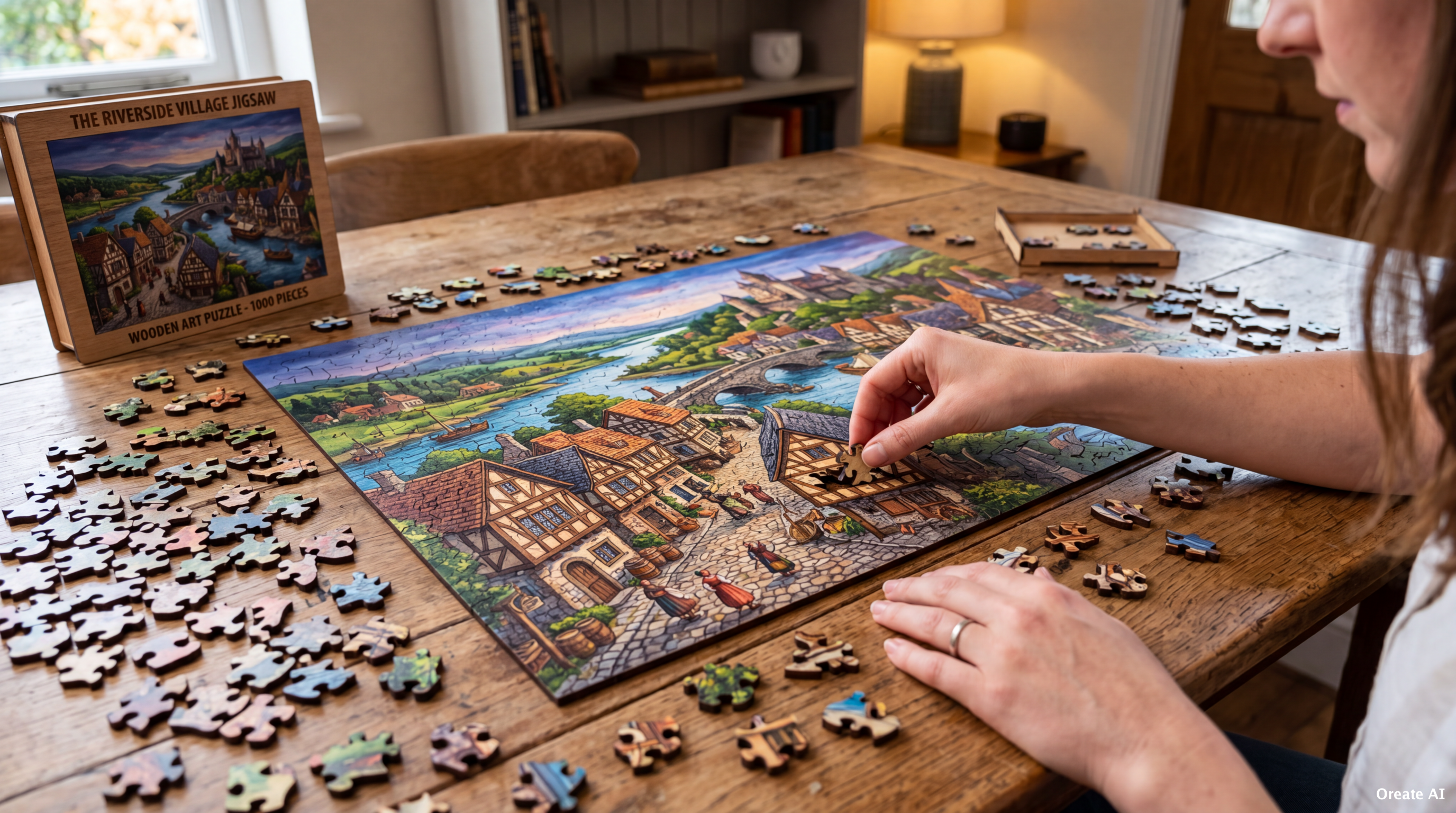
Not all wooden puzzles are created equal. Some leave you frustrated after an hour, still holding the same misshapen piece; others get solved in twenty minutes flat. The difference rarely comes down to luck; the design itself shapes the difficulty. Understanding those differences can change how you shop for your next puzzle.
Three areas drive the real gap in challenge: piece cut, image characteristics, and the material’s own properties. Master all three, and you’ll know exactly what you’re signing up for before a single piece hits the table.
How Piece Shape and Cut Style Set the Difficulty
Piece cut is the first thing to judge when you size up a wooden puzzle’s difficulty. You’ll find detailed wooden jigsaw puzzle designs that use irregular, hand-cut patterns alongside simpler grid-style patterns. The challenge gap between those two approaches is enormous.
Grid Cuts vs Whimsy Pieces
Standard grid cuts follow a predictable pattern; each piece has two tabs and two blanks, and the overall shape stays uniform. You can sort by edge alone and make steady progress. Whimsy pieces are the opposite: they’re cut into recognisable silhouettes (animals, letters, tools) with no predictable tab-blank arrangement. A single whimsy piece can sit in your hand and give you almost no positional clue.
Irregular Edges and Non-Interlocking Shapes
Some wooden puzzles use non-interlocking pieces that rely on fit rather than friction. Two neighbouring pieces might look nearly identical in outline; your brain can’t trust shape alone. You’re forced to rely on colour and image content, which doubles the cognitive load.
Straight-edged border pieces normally help you anchor the puzzle, but in designs where borders don’t form a rectangle, that anchor disappears. The catch is, you lose your foundational reference point.
Piece Count and Size Ratio
More pieces aren’t the only way to increase difficulty; smaller pieces relative to the total puzzle area matter just as much. A 500-piece wooden puzzle where each piece covers roughly 4cm² is far harder than a 1,000-piece puzzle where each piece is 8cm². Smaller pieces also punish poor lighting. The physical environment starts influencing your experience directly.
How the Image Design Affects the Challenge
The image printed on the wood is the second major source of difficulty. A piece shape alone can’t explain why two 300-piece puzzles feel completely different to solve.
Colour Uniformity and Low Contrast Areas
Photographs of clear blue skies, sandy beaches, or dense fog are notoriously hard because large sections share near-identical colours. Your only strategy becomes matching tiny tonal shifts, a slightly lighter patch of sky here, a faint texture in the sand there. Abstract designs, especially those with repeating geometric patterns, operate the same way: every piece looks plausible in multiple positions.
Fine Detail vs. Blank Space
Highly detailed images (close-up photography, dense illustrations, busy street scenes) give you more reference points per centimetre; you can cross-reference piece shape against image content simultaneously. Large areas of blank or single-tone colour strip that stand out. The trickiest designs deliberately mix both: a richly detailed centre surrounded by a flat, single-colour border.
Image Rotation and Symmetry
Symmetric images create false matches. You place a piece 180 degrees out, and it may look perfectly plausible until you’re three moves ahead and something doesn’t fit. But designs with strong directional lines (a horizon, a vanishing point) are more forgiving because the line tells you which way is up. Circular or radially symmetric images remove that directional cue entirely.
How Wood Quality and Finish Affect the Solve
Material choices shape difficulty in ways that don’t get talked about enough. Two puzzles with identical designs and piece counts can feel completely different depending on the wood and the laser-cutting quality.
Laser-Cut Precision and Piece Tolerance
Precision laser cutting produces pieces with tight, consistent tolerances. That sounds like it’d make things easier; actually, it raises the stakes. A wrong piece might click into place convincingly, only revealing the error later. Looser tolerances from cheaper manufacturing let wrong pieces fall away; you get instant tactile feedback on a bad fit.
Wood Thickness and Tactile Feedback
Thicker wooden pieces (typically 3- 5mm) sit steady on the table and resist sliding. Thin pieces (under 2mm) shift when you apply light pressure, which breaks your concentration and adds friction to an already slow process. And if you’ve ever tried to seat a piece in near-darkness while the surrounding pieces keep moving, thin wood is usually the culprit.
Surface Finish and Glare
A matte finish on the puzzle surface lets colours read accurately under standard indoor lighting. High-gloss finishes introduce glare, particularly under overhead lamps. That glare effectively reduces your colour information. The image that looked vivid on the box becomes harder to read mid-solve; you end up squinting at tonal differences you’d otherwise distinguish easily.
Conclusion
What makes some wooden puzzle designs more challenging than others comes down to piece cut style, image characteristics, and material quality, not just piece count. Irregular whimsy cuts, low-contrast images, and precision laser tolerances each add a distinct layer of difficulty. If you want a genuine challenge, look for designs that combine irregular pieces with large uniform-colour sections. Want something more straightforward? Choose images with strong contrast and a predictable border instead.